
SOLIS SOLUTIONS
Innovation through formulation. Solar system installation services.


Solar systems
3 main units
- Solar panels: these units trap sunlight in the form of direct current (DC)
- Inverter: This unit converts DC to alternating current (AC) which is the type of electricity supplied by ESKOM.
- Battery: Batteries store some energy for when the system is off (no sunlight).
The different power ratings:
- Kilowatt: This is the unit measurement of power. For example, a microwave is rated as 5KW.
- Kilowatt-hour (KWH): This is the measurement of how much electricity is being used. So, a 5KW microwave working for 1-hour uses 5KWH of electricity. For 2 hours it would use 10KWH of electricity (2hrs x 5KW= 10KWH).
How does it work?
The solar panels trap energy in the form of heat and convert this heat to DC. The inverter then converts DC to AC. This AC is the same current we are used to while on the grid. You could run a solar system without a battery, but it is unreliable. The battery ensures that there is always a backup stored energy for when there is not enough being produced.
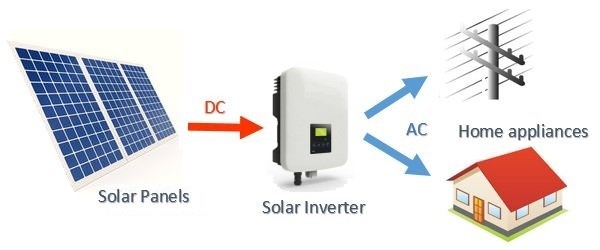
Solar systems can provide enough electricity to power an entire household if there are enough solar panels and batteries, but this is often too expensive. Normal solar systems cater to about 50% of a household’s electricity needs.
As an example:
- A 5KW system consists of a 5KW inverter, a 5KWH battery, and six 0.5 KW solar panels (the same as one 3KW solar panel).
- This system can produce roughly 30KWH of electricity daily (There is no calculation – this is found through research).
- An average household uses roughly 40KWH of electricity daily which costs R120. R3600 a month.
- This solar system can cater to half of the household’s needs thereby reducing the bill by 50% if used responsibly.
- Payback period of 4.5 year, thereafter the electricity you save is free!!!
Why don’t we go 100% off-grid?
Batteries are too expensive. Solar panels can trap enough sunlight to power a household easily, but the batteries needed to store the electricity produced would be too expensive.
Most solar systems are used to reduce energy costs during the day and grid electricity is used at night when electricity demand is low.
Inverters
The inverter is the brain of the solar system. Without the inverter, you would not be able to use the electricity you have trapped in the solar panels.
The inverter can be programmed to be used on certain devices. Television, refrigerators, air-conditioning, etc.
When reading the specifications on an inverter, you would see 2 things. A voltage (V) rating and a power rating (KW). The voltage rating indicated what voltage the inverter is operating at. This is the same voltage it would be able to supply to the battery and appliances.
Batteries
The batteries store some of the electricity created by the solar system. Not all electricity generated is stored in the battery as it goes straight from the inverter to the appliances. Surplus energy is used to charge the battery.
The stored energy (charged battery) is used at night and when there is increased demand (e.g. when there are too many appliances being used).
Some terminology used for batteries:
- Depth of discharge (DOD): refers to the capacity of the battery that is used until it needs to be charged.
- Cycles: refers to the number of times a battery can be emptied and recharged before it needs to be replaced.
- Contemporary Amperex Technology Limited (CATL): This is the name of the leading battery manufacturer worldwide. Companies often indicate CATL on their batteries as a sign of quality.
All units used in a solar system must be compatible with each other. Some batteries are not compatible with certain inverters and vice versa.
Our products
Inverters: Our inverters are rated 5KW. The 5KW inverter can convert more DC to AC and thus is used for higher energy demands.
Batteries: Our batteries can store 5.12 KWH of electricity. The higher the energy storage capacity, the more expensive the battery. Our batteries are LIFE PO4 batteries and include CATL lithium.
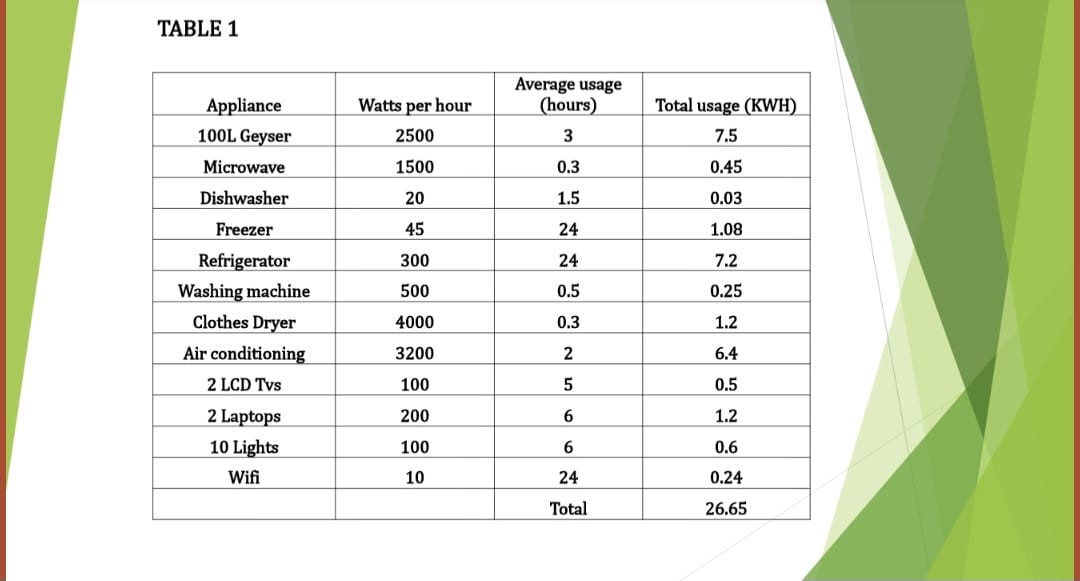
An example of a 5KW system and what it can power
Solis Solutions
Innovation through formulation.